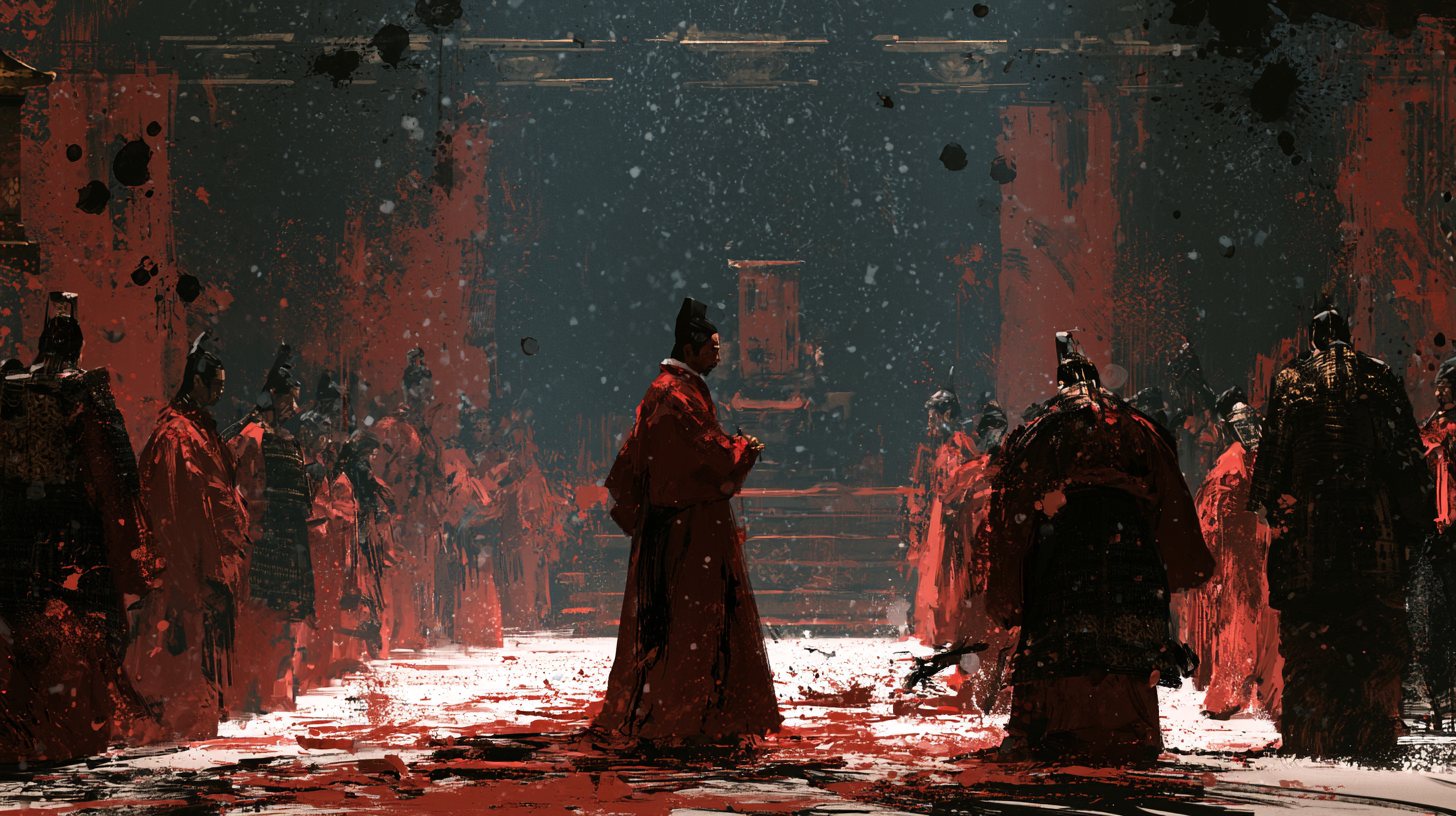
After Yūryaku came Seinei, Kenzō, Ninken and Buretsu. Through these reigns the royal line thinned rapidly.
Emperor Seinei had no children and no heir could be found. Then two brothers were discovered — sons of a prince killed by Yūryaku — living in hiding in Harima (modern Hyōgo) as keepers of horses and cattle. Revealing their birth at a banquet, they were welcomed to the capital, the younger reigning as Kenzō and the elder as Ninken.

But the twenty-fifth emperor, Buretsu, also left no heir. With that, the line descending from Emperor Jimmu faced complete extinction.
At a loss, the ministers traced a distant branch of the family. They sought out Ohodo, a fifth-generation descendant of Emperor Ōjin living far away in Echizen (modern Fukui), and welcomed him to the capital as the twenty-sixth emperor, Keitai.

A fifth-generation descendant is a very distant kinsman. For this reason, modern scholarship has often argued that a change of dynasty actually took place here — one of the greatest questions in ancient Japanese history.

The Kojiki records only the bare genealogy and says nothing of the politics. Yet beneath that brevity, it is not hard to sense currents that shook the foundations of the state.