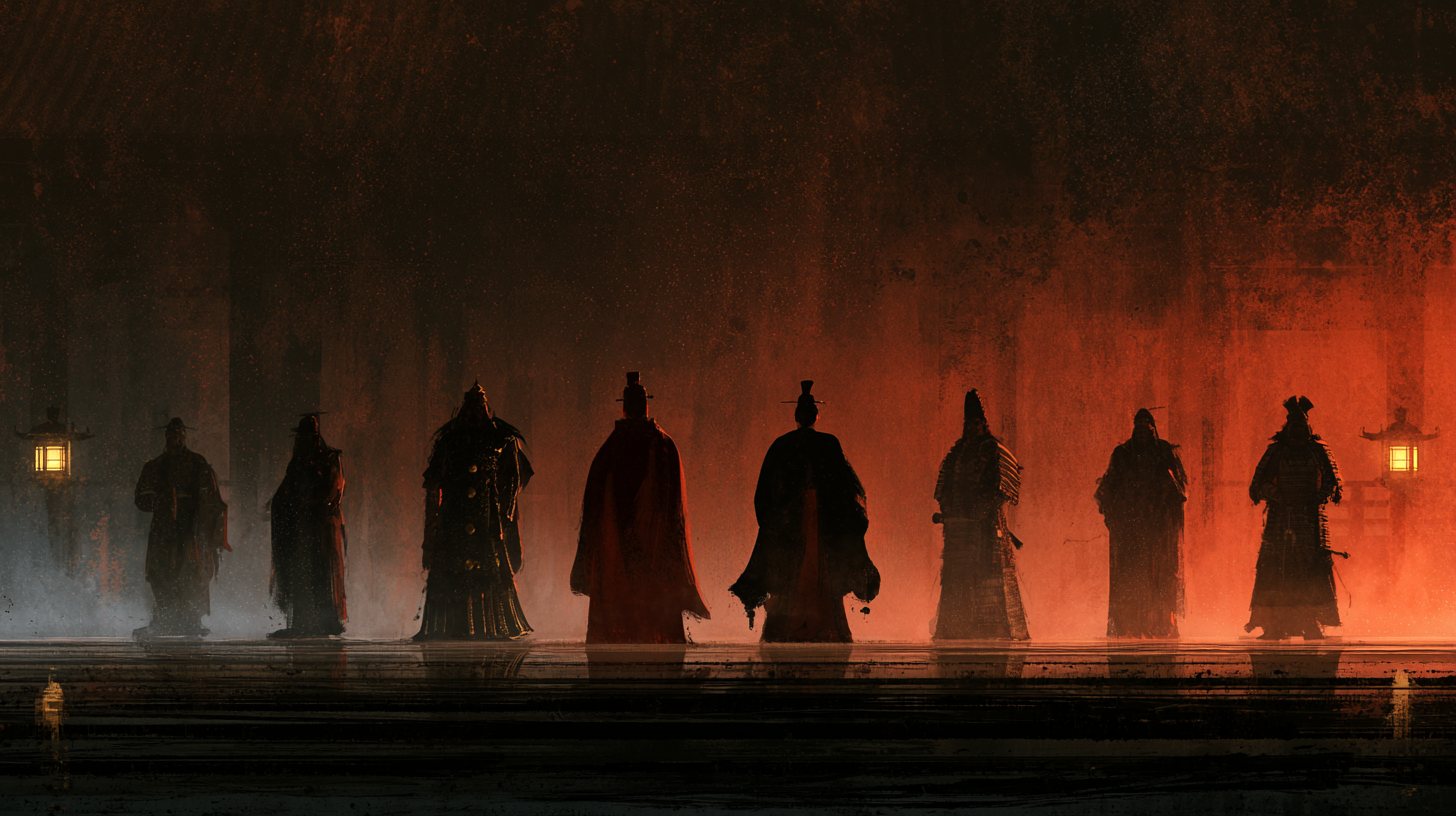
The Eight Undocumented Reigns

Chapter 2

The Eight Undocumented ReignsKesshi Hachidai

Eight emperors pass in silence, leaving only genealogy.

◀ Back to Book II
This retelling is a heavily condensed, dramatized modern version of the original Kojiki. Details may differ from the original text and scholarly translations.

After Emperor Jimmu died, a struggle broke out among his sons. One prince struck down his brothers and took the throne as the second emperor, Suizei. So began eight quiet reigns.

Suizei, Annei, Itoku, Kōshō, Kōan, Kōrei, Kōgen, Kaika. Of these eight the Kojiki records almost nothing but genealogy: where each held his palace, who his consorts were, which children were born, and where his tomb lies.

Eight quiet reigns
Eight quiet reigns

Later scholars named them the “eight undocumented reigns.” Were the stories lost, judged unnecessary, or were these generations added later to secure the continuity of the royal line? The debate continues.

Names kept in genealogy

Yet the eight reigns are not empty. Among the children of Emperor Kōrei is Kibitsuhiko, who would serve as one of the four generals under Emperor Sujin and who is often said to lie behind the legend of Momotarō. Quietly, the lineage branched and prepared the cast of the next age.

The line to the next age

Without a single famous episode, these silent generations still carry the story onward — to the reign of Emperor Sujin, and the next great turning point.

People & Deities

Emperor Suizei
綏靖天皇
The second emperor, who took the throne after a struggle with his brothers.
Emperor Kōrei
孝霊天皇
The seventh emperor, whose children include Kibitsuhiko.
Emperor Kaika
開化天皇
The ninth emperor; with his successor Sujin the narrative resumes.
Kibitsuhiko
吉備津彦命
Son of Kōrei who pacified Kibi; often linked to the Momotarō legend.

Background & Trivia

Why “undocumented”?
The term means “missing history.” Coined in later scholarship, it became a basis for doubting the historicity of these reigns.
The Momotarō connection
Kibitsuhiko’s defeat of the ogre Ura is regarded as the prototype of Okayama’s Momotarō, the Peach Boy.
Share this chapter✕LINEFacebook