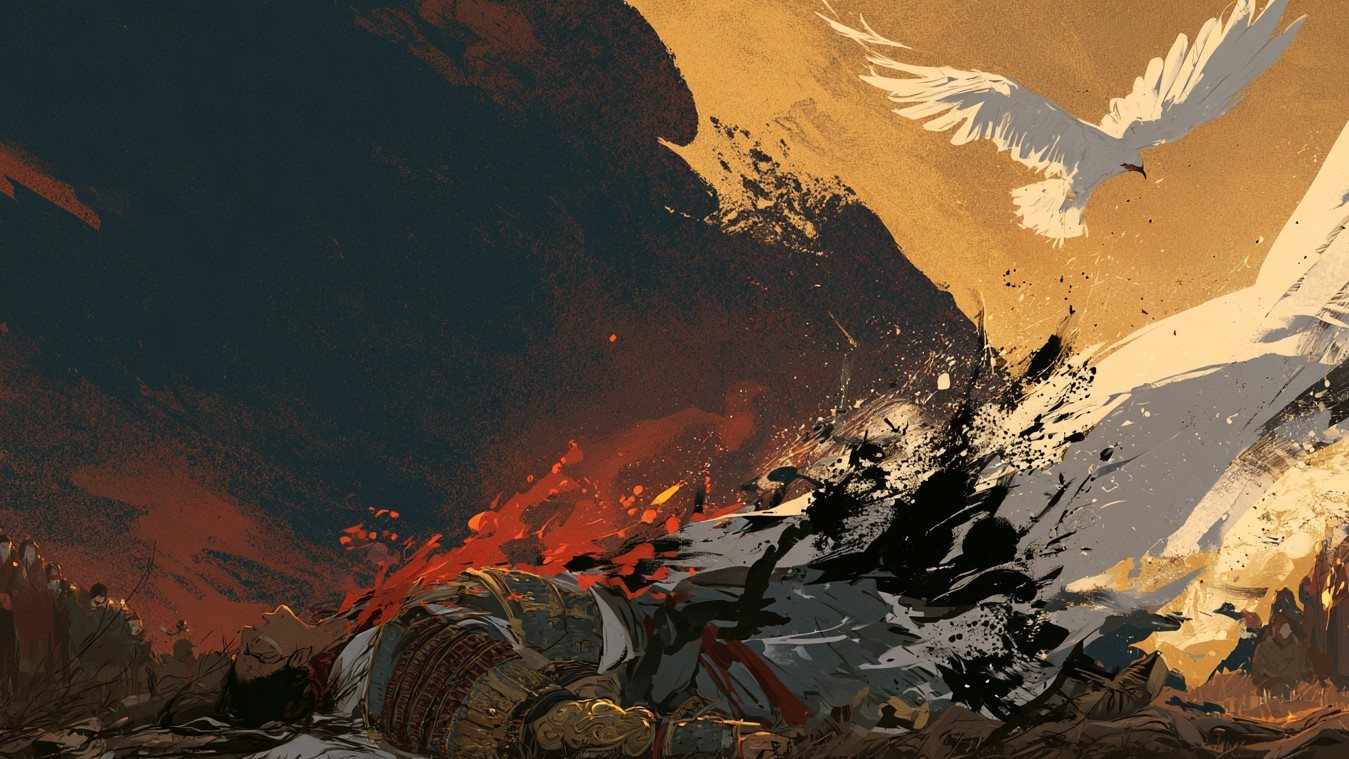
After pacifying the east, Yamato Takeru stopped in Owari and was wed to Miyazu-hime. Leaving the sword Kusanagi with her, he set out to strike the god of Mount Ibuki: “I will kill that mountain god with my bare hands.” It was a boast without his old caution.
As he climbed, a great white boar appeared on the path. “This must be the god’s messenger,” he said. “I will kill it on the way back.” But it was not a messenger: it was the god of Ibuki himself. Scorned, the god sent down a violent hail.

Struck by the storm, the prince lost his senses and staggered down the mountain. At the spring of Tamakurabe he came a little to himself, but his body would no longer obey him.
Leaning on a staff, he made for home, and on the way he sang: “Yamato is the highest place of all — ringed with green hedges of layered mountains; Yamato, the beautiful.” It is his song of longing for his homeland.

At Nobono his strength failed at last. His final song thought of the blade he had left behind: “The sword I left beside the maiden’s bed — oh, that sword.”

When his consorts and children came and raised a tomb, weeping, his soul rose as a white bird of vast wingspan and flew away toward the shore. Weeping, they followed; where it alighted in Kawachi they raised another tomb, called the Mausoleum of the White Bird. From there, they say, the bird rose once more and vanished into the sky.